
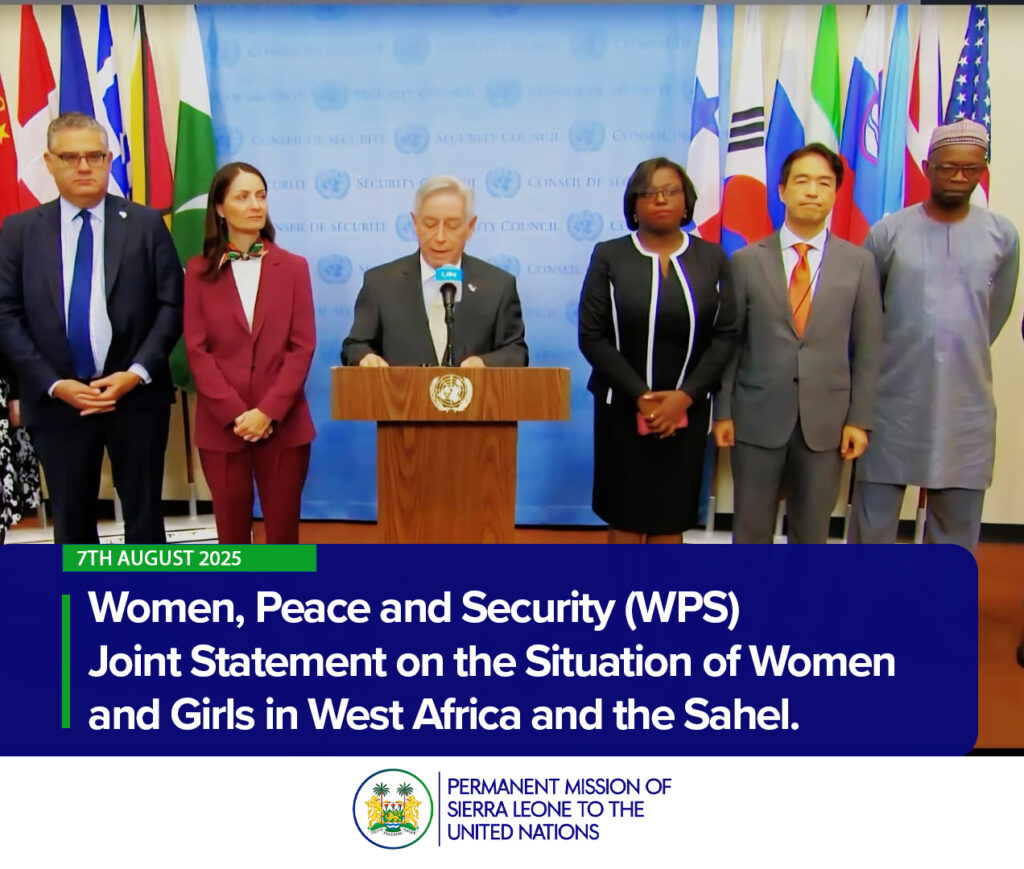
We, Denmark, France, Greece, Guyana, the Republic of Korea, Sierra Leone, Slovenia, the United Kingdom, and my own country Panama, signatories of the Shared Commitments on Women, Peace and Security of the Security Council, express our deepest concern over instability in West Africa and the Sahel, and its devastating impact on women and girls.
We reaffirm our commitment to advancing the implementation of the Women, Peace and Security Agenda as a condition for achieving peace, long term sustainable development and security in West Africa and the Sahel.
This region is facing multiple intersecting challenges. The erosion of democratic governance and of the institutional regional architecture, limited economic opportunities, and water and food insecurity have led to persisting transnational crime and forced displacement. These issues, exacerbated by the growing threats of terrorism and the effects of climate change, pose urgent and significant threats to international peace and security, and disproportionately impact women and girls.
The Sahel region continues to bear the brunt of terrorism, with violent extremist groups imposing severe social controls. These controls not only deprive women and girls of their fundamental rights but also restrict their participation in public life, enforce discriminatory norms and prejudices, and resort to public violence as a means of punishment for non-compliance. The use of sexual and gender-based violence by extremist groups is systematic.
Democratic backsliding and unconstitutional changes of government disproportionately affect women and girls, whose civic spaces and right to participate in public life remains restricted. The increase in militarized narratives risks undermining local and legitimate peace efforts, often led by women and women-led organizations.
The Sahel, despite its many challenges and risks due to environmental stress, has demonstrated remarkable resilience. It remains one of the most environmentally vulnerable regions, facing increasing floods and desertification. Communities continue to respond and adapt, even as these pressures cause significant livestock and crop losses and drive cross-regional displacement. Women’s livelihoods, rights, and agency are particularly affected by these impacts.
In this context, we:
- Urge governments, transitional authorities and regional actors to ensure the full, equal, safe and meaningful participation of women in political and transitional governance processes, including reconciliation, peacebuilding, and trust-building mechanisms.
- Reaffirm the centrality of gender equality in national and regional peacebuilding, early warning systems, and climate risk assessments, consistent with Resolution 2242 (2015).
- Demand access to justice and investigations into all cases of sexual and gender-based violence and ensure that victims and survivors have access to comprehensive post-trauma health, psychosocial and legal services and reintegration mechanisms.
- Recall the recommendation of the Secretary General that at least 15% of all Prevention of Violent Extremism funding be allocated towards advancing gender equality.
- Note the importance of gender-responsive peacebuilding, including the support provided to the region through the UN Peacebuilding Fund.
- Call for the strengthening of the capacities of the UN to support local community organizations to deliver responsive assistance to survivors and support women-led humanitarian, peacebuilding, and climate initiatives, including those led by young women.
- Encourage reporting from subregional organizations on their implementation of the Women, Peace and Security agenda.
- Call on the Security Council to extend and review, the mandate of UNOWAS in January 2026 and ensure that all its work continues to fully integrate WPS priorities.
Women and young people in this region are essential partners in peace and recovery. Ensuring their protection, participation, and leadership is necessary to strengthen trust, reconciliation, and lasting peace.
Thank you.