
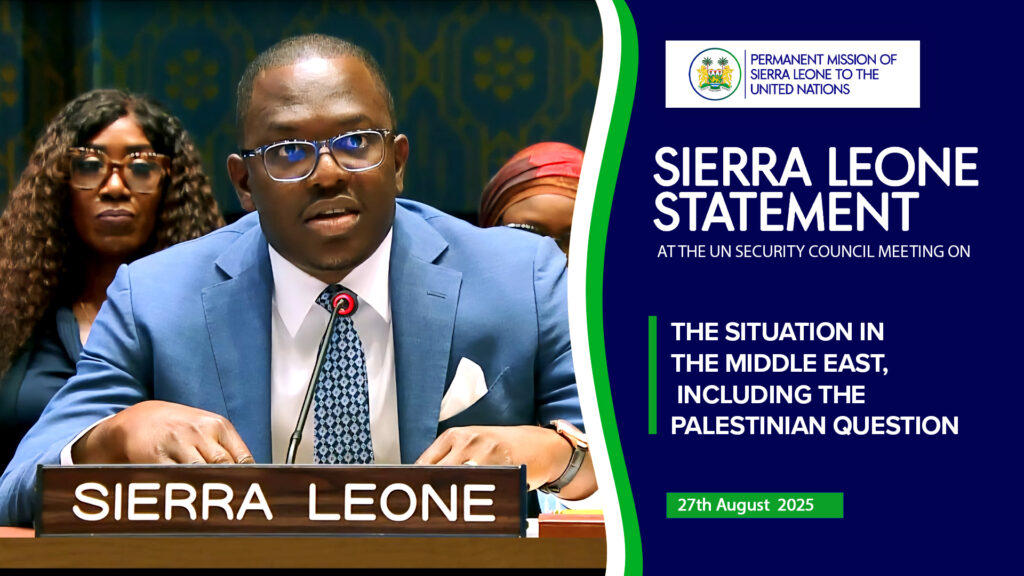
STATEMENT BY
H.E. DR. MICHAEL IMRAN KANU
AMBASSADOR AND PERMANENT REPRESENTATIVE
Thank you, Mr. President.
I thank Deputy Special Coordinator Ramiz Alakbarov, and Assistant Secretary-General Joyce Msuya, for their sobering briefings.
I also wish to thank Ms. Inger Ashing, Chief Executive Officer of Save the Children International, for shedding light on the deeply disturbing plight of children in Gaza.
To Ms. Ilana Gritzewsky, I wish to express my deepest sympathy for the horrors you endured and commend your courage in sharing such a painful experience. Sierra Leone has consistently condemned the heinous attacks of October 7, 2023, as well as the taking of hostages by Hamas and other armed groups. We reaffirm our strongest condemnation of these acts, which constitute grave breaches of international law.
Mr. President,
For nearly twenty months of our two-year tenure on this Council, whenever convened to address the Gaza conflict, we have asked ourselves how the situation could possibly become more brutal and inhumane. Each time we are confronted with new depths of suffering. From the decades-long occupation and blockade of Palestinian territory to the heinous Hamas attacks of 7 October 2023, to the ongoing plight of hostages and detainees, reported incidents of sexual violence, and now famine, the picture is one of mass atrocity crimes unfolding in real time. Distressingly, even international judges and prosecutors seeking accountability have faced threats and sanctions. Taken together, these elements point to credible indications of genocidal acts and intent that cannot be ignored.
On the dilemma of what more to say, we could today focus on recent atrocities, including the double strike on Gaza Nasser hospital. As a country that once benefitted from regional and international solidarity through ECOWAS and the United Nations during our most difficult days, Sierra Leone feels a deep responsibility to speak plainly on behalf of the victims and to urge an end to the ongoing inhumanity and indignity. We therefore offer the following observations:
First, amid this bleak picture, Sierra Leone wishes to commend the principled leadership of the UN Secretary-General António Guterres, and the work of the UN leadership and teams in the field. Throughout this crisis, the Secretary-General has spoken with clarity and courage, affirming that every war has rules and calling out violations of international humanitarian law. He has reminded the world that the horrors of Gaza did not happen in a vacuum, while condemning in equal measure the heinous terrorist attacks against Israeli civilians. For this he has faced vilification, yet his voice has been a moral compass in a time of deep division. Sierra Leone stands firmly in support of the Secretary-General’s continued calls for restraint, for compliance with international humanitarian law, and for an immediate humanitarian ceasefire.
Second, what is unfolding in Gaza is not random. It is a systematic pattern of atrocity crimes. We note reports of indiscriminate and disproportionate bombardments in densely populated areas; the deliberate deprivation of food, water, medicine, and fuel; the razing of entire neighbourhoods; attacks on hospitals, ambulances, and shelters; and the killing of journalists, medical workers, and aid staff.
The Integrated Food Security Phase Classification (IPC) Famine Review Committee has determined that famine (IPC Phase 5) is currently occurring in Gaza Governorate, and that Deir al-Balah and Khan Younis Governorates are identified as most vulnerable in the coming weeks. This famine is not a natural disaster. It is man-made, the result of deliberate obstruction and denial of humanitarian assistance.
Under international law, genocide includes killing members of a group and inflicting conditions of life calculated to bring about its physical destruction in whole or in part. Today, in Gaza, we see undeniable warning signs of exactly such destruction being inflicted on a civilian population. The International Criminal Court (ICC) has already issued arrest warrants that include the war crime of starvation. The International Court of Justice (ICJ) has ordered the Government of Israel to take all measures to prevent genocide and to enable humanitarian relief. Yet the devastation continues, and the orders of the ICJ are openly disregarded.
This pattern is not confined to Gaza. In the West Bank, including East Jerusalem, we see a parallel strategy. A surge in settler violence, the expansion of illegal settlements, and plans that threaten to sever territorial contiguity. Entire communities are being uprooted, with the clear effect of rendering life unviable for Palestinians and making the ‘two-state’ solution increasingly unviable. Sierra Leone views these developments with grave concern. The parallels to ethnic cleansing are unmistakable.
Third, we must also note the systematic assault on truth itself. As stated, the Secretary-General has been subjected to campaigns of vilification simply for speaking truthfully. The United Nations and its agencies have faced unsupported accusations. Even UN facilities, including schools and shelters, have been struck, undermining their essential humanitarian work. Journalists and media workers have paid with their lives in unprecedented numbers. News bureaus have been bombed, communications cut, and reporting stifled. Medical personnel, doctors, nurses, and paramedics, have been attacked in clearly marked facilities and ambulances. Independent experts have described this as a war on healthcare.
At the very least, these attacks amount to war crimes and crimes against humanity. Silencing those who bear witness to suffering is an attack on truth and human dignity. Without truth, atrocity flourishes unchecked. We therefore call on all parties to respect the independence of the United Nations and ensure the safety of humanitarian actors, journalists, and medical workers.
Mr. President,
This Council was created to respond to threats to international peace and security, and to prevent the very horrors we are now witnessing. Yet despite overwhelming evidence of atrocity crimes, our response has been disturbingly paralyzed. This echoes the darkest chapters of the 1990s, when the Council was rebuked for its failures during the genocides in Rwanda and in Srebrenica. Then, the world asked how the international community could stand by in silence. Today, the same question will be asked of us in our failure to act.
The Genocide Convention obliges all States not only to punish but also to prevent genocide. Inaction or paralysis in the face of clear warning signs is not neutrality. It is complicity. Inaction and indifference may equal complicity. Future generations will look back and ask whether this Council did everything in its power to stop an atrocity in real time. History’s judgment will be unforgiving if we fail to rise to this moment.
The path forward is clear. We have listened carefully to the parties. From the State of Palestine, the calls are clear, an immediate ceasefire, renewed commitment to the Arab Peace Initiative, disarmament of Hamas, and a reinvigorated pursuit of a two-state solution. From Israel, we hear the imperative of freeing hostages, the need for security, and the desire to live in peace and normalization with Middle Eastern States.
These objectives are not mutually exclusive. They are interdependent. A cessation of hostilities is indispensable to save Palestinian lives and uphold their rights, just as the release of hostages and security guarantees are indispensable for Israelis.
There must be an immediate, comprehensive, and sustained humanitarian ceasefire. There must be unfettered humanitarian access, with all crossings opened for food, medicine, fuel, and water. There must be the immediate and unconditional release of all hostages, and humane treatment for all detainees. There must be an end to collective punishment and attacks on civilians, hospitals, journalists, and UN facilities. And there must be accountability for atrocity crimes through support for the ICC and the UN’s investigative mechanisms. The Council should also consider measures, including restrictions on arms transfers, to halt the means by which atrocity crimes are being committed.
The core purpose of the United Nations is to save succeeding generations from the scourge of war and to reaffirm faith in fundamental human rights. In Gaza today, we face a moral test that will define our legacy. ‘Never again’ was the vow made after the genocides of the last century, but it becomes meaningless if we turn away now. Sierra Leone’s position is clear: we cannot be silent, we will not be complicit, and we will continue to raise our voice for the victims.
Major-General Henry Kwami Anyidoho, who served as Deputy Force Commander of the UN peacekeeping mission in Rwanda in 1994, once recalled that when confronted with a difficult choice, “we had to act according to the dictates of our conscience.” This is such a moment. For the sake of international law, for the sake of humanity, and for the children who are starving as we speak, the time for action is now.
I thank you.
