
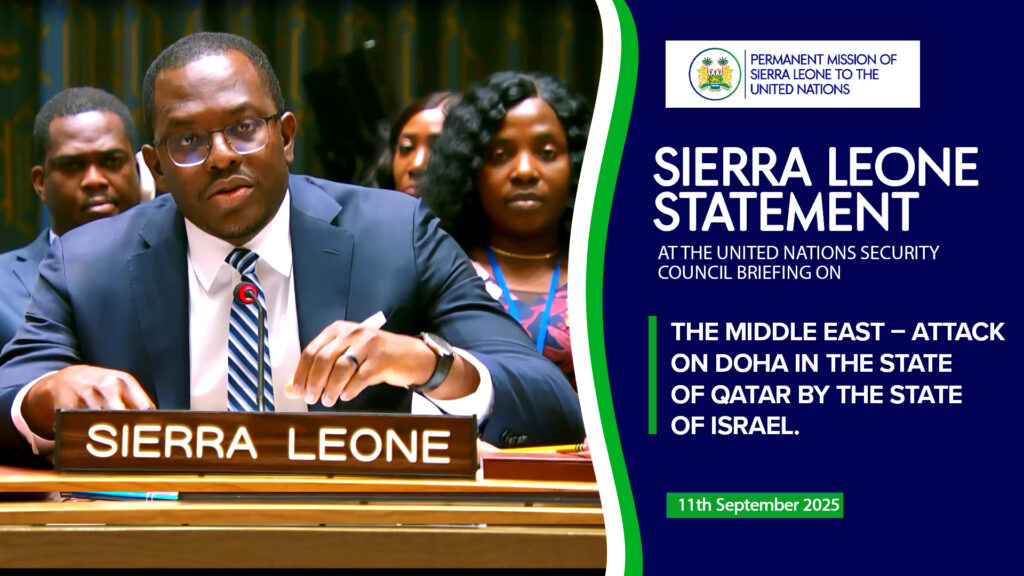
STATEMENT BY
H.E. DR. MICHEAL IMRAN KANU
AMBASSADOR AND PERMANENT REPRESENTATIVE
Mr. President,
I thank you for convening this emergency meeting of the Security Council. I also thank Under-Secretary-General Rosemary DiCarlo for her briefing.
Although in very difficult circumstances, we welcome to the Council His Excellency Sheikh Mohammed bin Abdulrahman bin Jassim Al-Thani, Prime Minister and Minister for Foreign Affairs of the State of Qatar and express not only the solidarity of Sierra Leone, but also our commendation for Qatar’s valuable global mediation efforts in conflict situations, particularly in the Middle East as well as Africa. We also welcome to the Council His Excellency Mr. Ayman Safadi, Deputy Prime Minister and Minister for Foreign Affairs and Expatriates of Jordan.
Sierra Leone notes the letter dated 9 September 2025 from the Permanent Representative of the State of Qatar, transmitted as document S/2025/563, which draws the Council’s attention to the grave incident that has prompted our deliberations.
Sierra Leone has consistently upheld the conviction that the Middle East conflict, and in particular the Palestine Question, must be resolved through peaceful means in accordance with the Charter of the United Nations. Article 2(3) obliges all Member States to settle their disputes by negotiation, mediation, conciliation, arbitration, or other peaceful means, while refraining from the threat or use of force, not to endanger international peace and security.
It is in this light that my delegation is deeply alarmed by the admission by the Prime Minister of the State of Israel of his government’s attack on Doha, the capital of Qatar, a State playing an active role as a mediator between Israel and Hamas in the ongoing escalation of the conflict in Gaza.
Qatar’s facilitation of dialogue has been indispensable to sustaining fragile ceasefire arrangements and preventing further escalation in Gaza. An assault on the territory of a mediator is not only a violation of its sovereignty, but also a direct strike at the very architecture of diplomacy. As the UN Secretary-General has rightly stressed, all parties should be working towards a permanent ceasefire, not undermining it.
Sierra Leone is gravely alarmed by this flagrant breach of international law. We strongly condemn Israel’s attack in Doha and we fully support the Press Statement just agreed by Council Members which emphasizes the vital role that Qatar continues to play in mediation efforts in the region, and alongside Egypt and the United States.
We take note of the communications from the Permanent Mission of Qatar and the Gulf Cooperation Council Member States, which describe the strike as a “serious threat to the security and safety” of Qataris and residents. Such actions constitute a grave breach of Article 2(4) of the Charter, which prohibits the threat or use of force against the territorial integrity or political independence of any State. Sovereignty and territorial integrity are cornerstones of our collective security system.
As we strongly condemn the Doha attack by the State of Israel, we commend the restraint demonstrated by the State of Qatar. Sierra Leone calls for the continuation of the exercise of maximum restraint, the peaceful resolution of disputes, and full respect for the sovereignty and territorial integrity of the State of Qatar, in compliance with international law, the Charter of the United Nations, and the provisions of relevant Security Council resolutions. States with influence must leverage such influence for de-escalation and peace in the region.
Mr. President,
Beyond the violation of sovereignty, Sierra Leone is gravely disturbed by reports of targeted assassinations of individuals who should be considered “protected persons” under international humanitarian law. Equally troubling are reports of such assassinations in residential areas. The Geneva Conventions, particularly the Fourth Convention, and their Additional Protocols, clearly prohibit violence against civilians and all persons not taking a direct part in hostilities. The Geneva Conventions explicitly forbid violence to life and person, in particular murder of all kinds, against those taking no active part in hostilities.
Mediators, negotiators, medical personnel, journalists, humanitarian staff, and civilians remain under the protection of international law. Willful killing of such persons constitutes a grave breach of the Geneva Conventions and a war crime under the Rome Statute of the International Criminal Court. We are appalled by the deliberate targeting of civilians and mediators under safe conduct, acts that undermine the distinction between combatants and non-combatants, including those not taking part in hostilities, with no continuous combat function, and outside areas of hostilities.
We must be clear, international law does not recognize revenge. International law recognizes only lawful self-defence on the use of force against imminent unlawful attack or collective action authorized by the Security Council. Acts motivated by revenge, retaliation are illegal. No justification can excuse deliberate attacks on those who are not engaged in active combat functions.
Colleagues, these developments point to a larger challenge confronting the international community, the persistence of impunity in the face of serious violations of the UN Charter and international law. When such acts are met with silence or selective responses, perpetrators are emboldened to continue, eroding the credibility and weakening the rules-based international legal order.
For the Council, failure to respond risks reducing this body to a bystander in the very crises it is mandated to address and would amount to a referendum on the system we have built.
Sierra Leone therefore urges this Council to reaffirm unequivocally the inviolability of the sovereignty and territorial integrity of Qatar and all Member States, to ensure that unlawful assassinations of protected persons are thoroughly investigated; to hold perpetrators accountable under international law; and to redouble efforts to bring the current conflict to an end through genuine good faith negotiations leading to a just and lasting peace.
Mr. President,
As we speak to the violation of the sovereignty of the State of Qatar, in the State of Palestine, in both the West Bank and Gaza, the inhumanity continues with the ongoing hostilities. We remain gravely concerned about the humanitarian catastrophe in the Gaza Strip, with the declared famine, bombardments and evacuation orders in Gaza City, mass displacement, and acts and rhetoric evincing genocidal intent.
We are equally gravely concerned about the plight of hostages and recall with condemnation the 8 September attack on Israeli civilians at a Jerusalem bus stop, in which six people were killed and eight others wounded. Violence on either side will only breed more violence, deepen suffering, and erode prospects for peace. We reiterate the imperative for an immediate ceasefire, the safe and unimpeded delivery of humanitarian aid, and the release of all hostages.
The Council must demand a ceasefire, particularly when a mediator State has been so flagrantly attacked. The peoples of the Middle East, and indeed the peoples of the world, look to this Council for leadership, consistency, and resolve. Upholding the Charter is not optional; it is a binding obligation.
Sovereignty must be respected, civilians and other protected persons must be safeguarded, and international law must be enforced without fear or favour. Only by doing so can we end impunity, restore confidence in the rules-based international legal order, and open the path to peace.
As the Irish poet William Butler Yeats warned in The Second Coming, immortalized in Things Fall Apart by the Nigerian author Chinua Achebe, “Things fall apart; the centre cannot hold; Mere anarchy is loosed upon the world.” The United Nations is the centre of the post-1945 multilateral rules-based system, and the Security Council its nucleus for peace and security. We must act now with unity and determination. Anything less would betray our collective responsibility and the trust that the peoples of the world have placed in us. This system as we know it risks falling apart, and anarchy would indeed be loosed upon the world.
I thank you.