
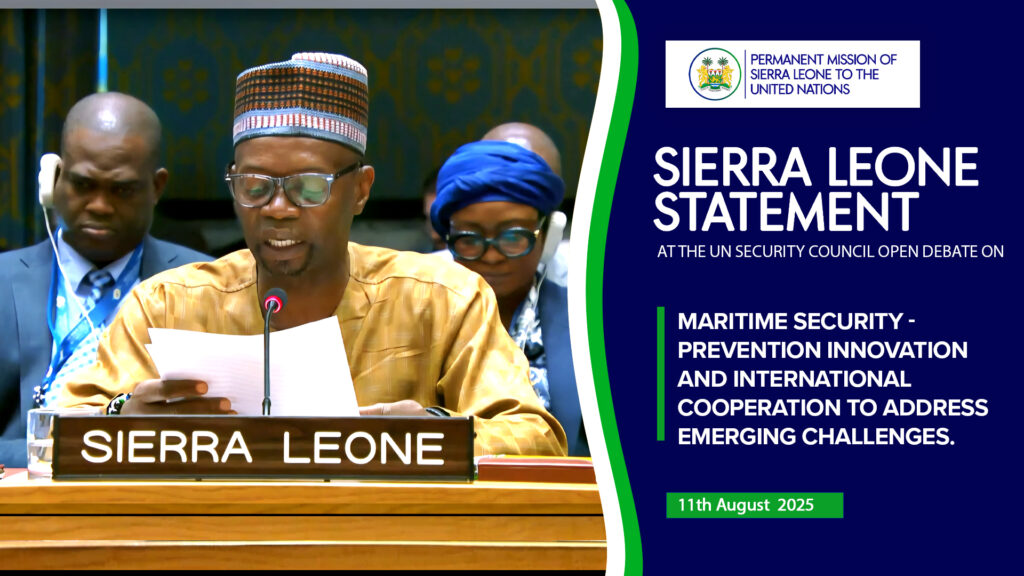
STATEMENT BY
H.E. MR. KALILU IBRAHIM TOTANGI
AMBASSADOR AND DEPUTY PERMANENT REPRESENTATIVE /CHARGE D’AFFAIRES A.I.
Mr. President,
I warmly welcome Your Excellency José Raúl Mulino, President of the Republic of Panama, to the Council, and commend Panama’s leadership in convening this important high-level open debate.
We extend our appreciation to Mr. Arsenio Domínguez, Secretary-General of the International Maritime Organization; Mr. Ricaurte Vásquez, Chief Executive Officer of the Panama Canal Authority; and Mr. Valdecy Urquiza, Secretary-General of INTERPOL, for their comprehensive and important briefings.
Sierra Leone values this timely discussion, which reinforces our shared responsibility to safeguard the oceans as vital conduits for global peace, economic stability, and environmental sustainability. The interlinkages between these objectives reflect the spirit of multilateralism and international law, as underscored in the Pact for the Future.
We acknowledge, with particular appreciation, the administration by Panama of the Panama Canal, one of the most important and strategic waterways in the world. For decades, this neutral and secure passage has facilitated the peaceful and uninterrupted transit of vessels of all nations, connecting the Atlantic and Pacific Oceans, and sustaining global trade. It is a model of how international maritime infrastructure can be managed responsibly for the global common good, balancing commercial, environmental, and security considerations.
With over 80 per cent of global trade by volume and the vast majority of international data traffic dependent on undersea cables, maritime supply chains remain the backbone of the global economy. Yet, they face intensifying threats, ranging from piracy, armed robbery, and terrorism to illicit trafficking, illegal, unreported and unregulated (IUU) fishing, environmental degradation, climate change, and emerging risks from drones, cyberattacks, “shadow fleets,” and the misuse of artificial intelligence.
The Pact for the Future, in this regard, calls for collective action to safeguard maritime trade routes, strengthen governance, enhance capacity-building, and improve cooperation to protect marine resources and critical infrastructure.
Mr. President, in light of the foregoing allow me to highlight three key points:
First, complex and evolving maritime threats jeopardize both the safety of sea routes and the socio-economic development of coastal and landlocked States alike. In West Africa, for example, shifts in global shipping routes due to hostilities in the Red Sea and Black Sea have increased activity along the Gulf of Guinea, heightening the risk of smuggling, terrorism, and piracy. An attack on ports in this corridor would have cascading consequences for trade, revenue, and food security in the region, impacting not only coastal nations such as Senegal, Côte d’Ivoire, and Nigeria, but also landlocked countries like the Central African Republic that depend on these ports.
Second, maritime security requires harmonised and mutually reinforcing global, regional, and national responses. The United Nations Convention on the Law of the Sea (UNCLOS), relevant Security Council and General Assembly resolutions, and regional instruments such as the Djibouti Code of Conduct, the Yaoundé Architecture, the Lomé Charter, and the African Union’s 2050 Integrated Maritime Strategy provide an essential framework. Their implementation must be supported by sustainable financing, capacity-building, and inclusive participation. We commend the IMO’s leadership and note with appreciation the contributions of cooperative mechanisms such as the African Maritime Law Enforcement Partnership, Combined Task Force 151, and EU NAVFOR Somalia, which have significantly reduced piracy incidents in the Horn of Africa and Western Indian Ocean.
Addressing IUU fishing, estimated to cost Africa over $2 billion annually, remains critical. Such practices erode livelihoods, undermine biodiversity, and weaken governance. Initiatives in Ghana, Liberia, Mauritania, Senegal, and Sierra Leone, supported by FAO and civil society, show the value of strengthened transshipment controls and community-based enforcement.
Third, climate change, pollution, and environmental degradation act as risk multipliers for maritime security, disrupting operations and fuelling competition over resources. Leveraging innovative and safe technologies—such as the Automatic Identification System (AIS), satellite monitoring, drones, and IoT-enabled systems—can enhance maritime domain awareness, surveillance, operational readiness, and environmental protection. The Panama Canal’s integration of such systems offers a valuable example of resilience and cyber-security in port and canal management.
In particular, AIS, satellite networks, unmanned surface vehicles, and advanced sensor systems improve real-time vessel tracking, situational awareness, and threat detection, whether for illegal fishing, oil spills, or other maritime hazards.
In closing, Mr. President, Sierra Leone calls for a strengthened global governance framework for maritime security, rooted in UNCLOS, aligned with the Pact for the Future, and advancing sustainable development, climate resilience, and the fight against transnational crime. This should include open and transparent information-sharing between States, multilateral and regional organisations, and the private sector, as well as the responsible and equitable use of technology under clear regulations and oversight.
The challenges are shared and so must be our solutions. Let us work together to ensure that the world’s oceans remain secure, sustainable, and open for the benefit of all humankind.
I thank you.