
Photos and video courtesy of UN webtv
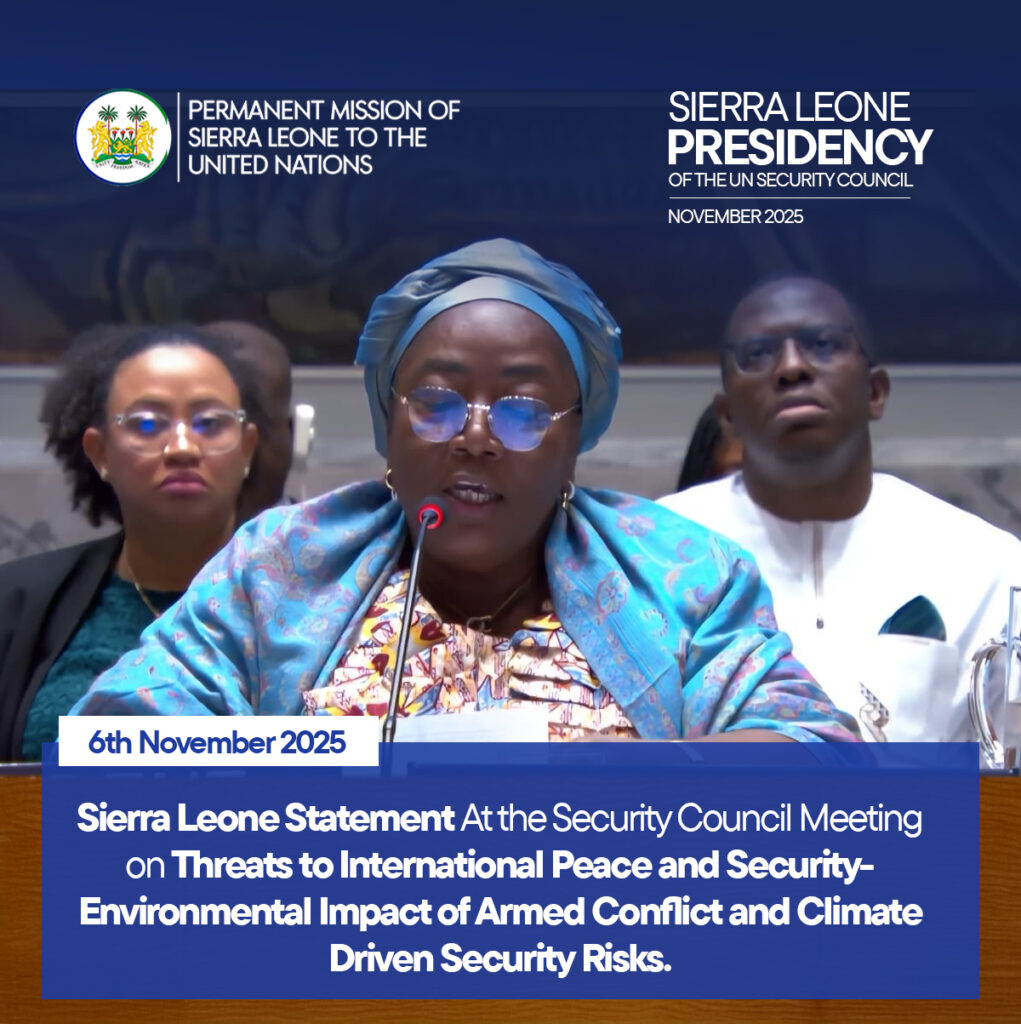
November 6th 2025

At the Security Council Meeting on Threats to International Peace and Security- Environmental Impact of Armed Conflict and Climate Driven Security Risks.
The Meeting was chaired by Sierra Leone’s Deputy Minister of Foreign Affairs and International Cooperation, H.E. Madam Francess Piagie Alghali. The briefers were Under-Secretary-General Inger Andersen, Executive Director of the UN Environment Programme (UNEP); Professor Charles Chernor Jalloh, Member of the International Law Commission; and Ms. Maranatha Dinat, World Relief Haiti.
On this International Day for Preventing the Exploitation of the Environment in War and Armed Conflict, Sierra Leone’s Deputy Minister for Foreign Affairs, H.E. Madam Francess Piagie Alghali shed light on the 2025 designation of Tiwai Island and the Gola Forest as UNESCO World Heritage Sites, as “a triumph of conservation and nurture”, underscoring “how environmental restoration, when integrated into peacebuilding, can yield lasting stability.”
Sierra Leone highlighted how conflict “dynamics intensify fragility, drive displacement, and heighten food insecurity from the Sahel and the Great Lakes to Sudan to Ukraine’s damaged industrial and agricultural landscapes,”
Spotlighting Gaza as an example, Sierra Leone stated that the
“scale and character of the damage raise serious concerns under international humanitarian law, which prohibits warfare expected to cause widespread, long-term, and severe harm to the environment”, and that “Absent urgent, coordinated recovery, safe debris clearance, soil and water remediation, and ecological restoration, Gaza faces a protracted environmental emergency that will endanger civilians and impede sustainable recovery for years to come.”
Sierra Leone offered six recommendations:
First, “on mainstreaming risk in Council practice. The Security Council should systematically integrate conflict-linked environmental and climate risks into mandates, Secretary-General’s reports, political guidance, and mission planning.”
Second, “on ensuring a coherent international architecture…..The Security Council must play its part on the security-related aspects, ensuring a multidimensional and effective response that bridges peace and security, humanitarian action, development, and the rule of law.”
Third, “
on protecting the natural environment under international law, including IHL. Parties to conflict must be reminded of their obligations to protect the natural environment…”
Fourth, on “implementation and accountability. Sierra Leone supports enhanced cooperation to monitor, document, and remediate environmental damage, including capacity-building for data collection, environmental forensics, and transparent reporting.”
Fifth, “from debris to resilient recovery. Safe debris management, hazardous-waste handling, and resilient reconstruction are critical to public health and environmental recovery after conflict”.
Sixth, “on financing what we mandate. Predictable, accessible financing is urgently needed for environmental remediation and climate adaptation in fragile and conflict-affected settings.”

H.E. Madam Francess Piagie Alghali.

Professor Charles Chernor Jalloh

Maranatha Dinat, World Relief Haiti

Inger Andersen, Under-Secretary-General Inger