
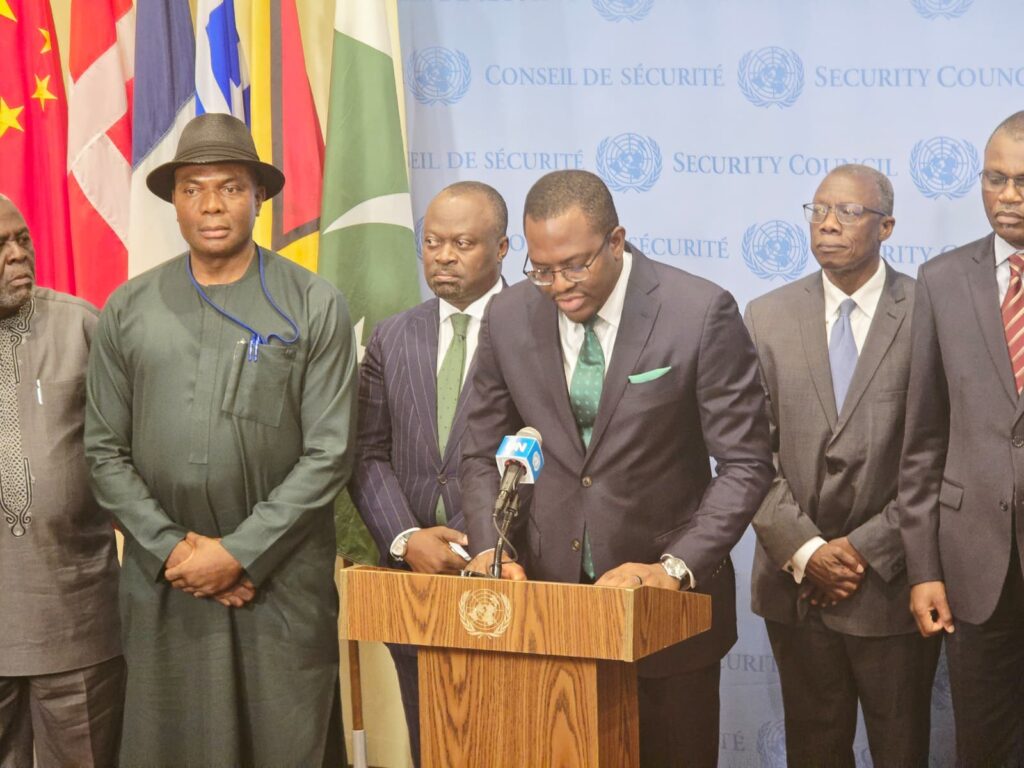
We have the honour to deliver this statement on behalf of [Algeria, Côte d’Ivoire, Ghana, Guinea, Guinea-Bissau, Guyana, Liberia, Sénégal, Somalia, Sierra Leone, Togo] to reaffirm our unwavering commitment to regional cooperation, particularly in the fight against terrorism in West Africa and the Sahel.
As ECOWAS marks its 50th anniversary this year, we commend its pivotal role in advancing peace, stability, and regional integration across West Africa. Over the decades, ECOWAS institutions have promoted good governance, strengthened the rule of law, supported peacekeeping operations, deepened regional integration, and advanced trade liberalization for the socio-economic development of its people.
As a major threat to the consolidation of the significant achievements, the West Africa and Sahel region currently faces the scourge of international terrorism, with the Central Sahel emerging as the global epicentre, accounting for over half of all terrorism-related deaths in 2024, and with risk of its spread to coastal states. Terrorist groups, including Jama‘at Nusrat al-Islam wal-Muslimin (JNIM), the Islamic State in the Greater Sahara (ISGS), and affiliates of ISIL (Da’esh) and Al-Qaida, continue to perpetrate attacks with increasing intensity and sophistication.
We strongly condemn all acts of terrorism and express grave concern over the use of unmanned aerial systems, anti-aircraft capabilities, and improvised explosive devices (IEDs) to target civilians and civilian infrastructure. The deliberate targeting of children, the recruitment and radicalization of youth, attacks on schools and healthcare facilities, and restrictions on humanitarian access have compounded human suffering. These threats are further aggravated by ethnic and communal tensions, particularly between herders and farmers, and exacerbated by the adverse effects of climate change, which perpetuate cycles of violence.
As of May 2025, more than 6.5 million people have been internally displaced across the directly affected States, while over 47 million face acute food insecurity, with famine conditions emerging in the most vulnerable regions. We are deeply alarmed by the growing number of cross-border incidents, especially in littoral States, underscoring that terrorism recognizes no borders. These challenges demand a unified, coordinated, and sustained response.
We welcome the previous and sustained efforts of regional mechanisms and institutions, including the Multinational Joint Task Force (MNJTF), and the Accra Initiative, and look forward to the activation of the ECOWAS Standby Force. We commend the strategic planning being implemented under the ECOWAS Counter-Terrorism Strategy and the ongoing cooperation between ECOWAS and the African Union, and the constructive engagement with the Alliance of Sahel States. In this regard, we appreciate the contributions of institutions such as the Kofi Annan International Peacekeeping Training Centre, which continues to provide critical training and research to support these initiatives.
We also recognize the indispensable role of the United Nations in supporting efforts to counter terrorism and sustain peace in West Africa and the Sahel. In particular, we acknowledge the contributions of the United Nations Office on Drugs and Crime (UNODC) and the Counter-Terrorism Executive Directorate (CTED) in strengthening national and regional counter-terrorism capacities.
We further commend the critical work of the United Nations Office for West Africa and the Sahel (UNOWAS), including the preventive diplomacy and good offices undertaken by the Special Representative of the Secretary-General, Leonardo Simão, in promoting political dialogue, fostering regional cooperation, and addressing the underlying drivers of conflict and violent extremism. We stress the importance of predictable, adequate, and sustainable financing for African Union-led peace support operations, in line with the implementation of Security Council Resolution 2719.
Furthermore, we underline the importance of the full, equal, and meaningful participation of women, as well as the inclusion of youth, who constitute 65% of the region’s population, as central to building resilience and sustaining peace. We welcome ongoing efforts to deepen understanding of the nexus between climate change and peace and security in the region, and to develop evidence-based programs that address climate-related risks and the conditions conducive to violent extremism arising from environmental degradation.
In conclusion, we reaffirm that regional leadership, complemented by multilateral cooperation, remains the cornerstone of our collective efforts to counter terrorism and violent extremism. At this historic juncture, we must translate policy into concrete action.
I thank you.


