
STATEMENT BY
H.E. DR. MICHAEL IMRAN KANU
AMBASSADOR & PERMANENT REPRESENTATIVE
Colleagues,
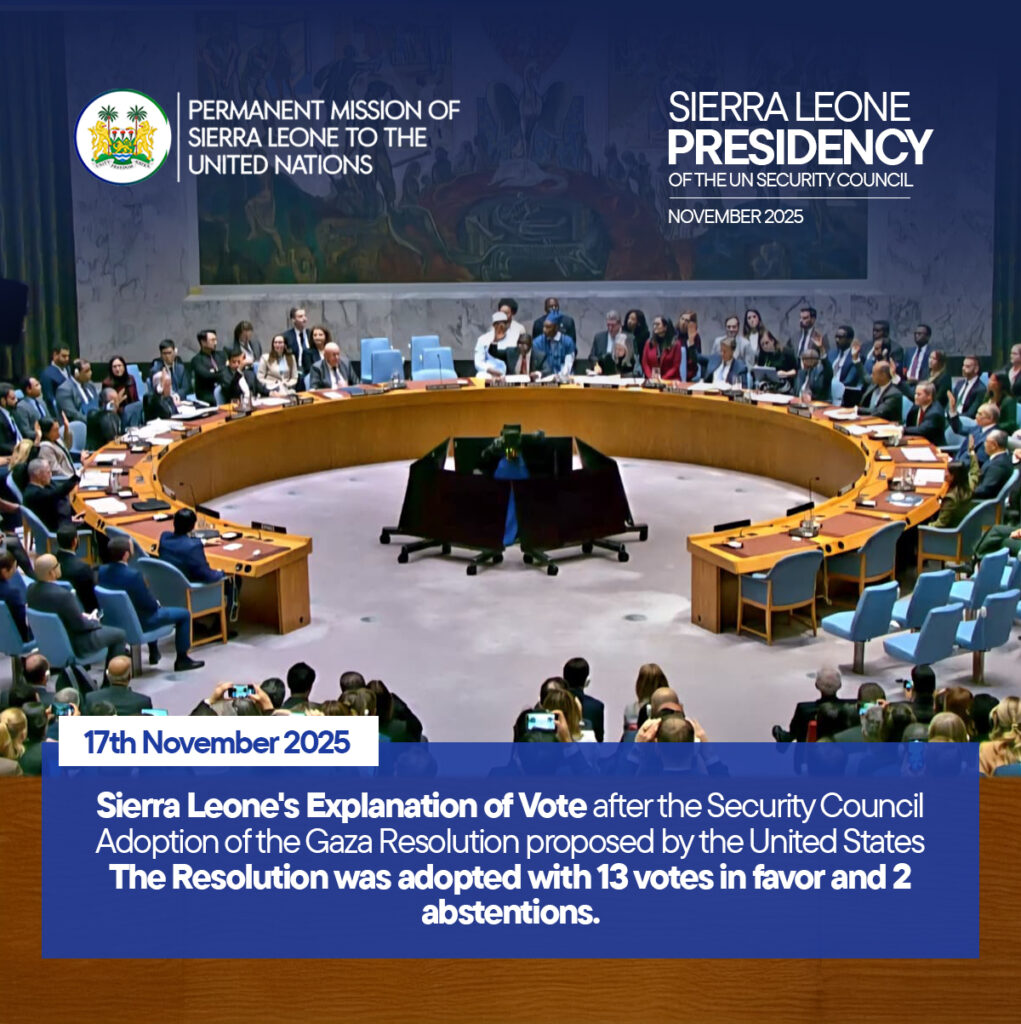
1. Sierra Leone thanks the United States for coordinating the process that culminated in the tabling of the resolutionjust adopted by the Council. We further thank President Donald J. Trump for his leadership, and also thank the other mediators, Egypt, Qatar and Türkiye for their commendable efforts.
2. Sierra Leone voted in favour of the resolution 2803. We did so mindful of our responsibilities as a member of the Committee on the Exercise of the Inalienable Rights of the Palestinian People, and of our longstanding support for a just and lasting peace in the Middle East grounded in international law, the protection of civilians, and a negotiated two-State solution, with an independent, viable and contiguous State of Palestine living side by side with Israel in peace and security.
3. Our vote also took careful account of the fact that the draft has been accepted by the Palestinian Authority and has received support from a number of States in the region that are closely engaged with the peace efforts. Their views, and their readiness to work with this framework, were an important consideration for Sierra Leone in assessing whether the resolution could, if implemented in good faith, contribute to de-escalation and create space for a political process.
4. Throughout the negotiations, Sierra Leone was guided by four core principles: First, safeguarding the inalienable right of the Palestinian people to self-determination; second, ensuring the protection of civilians and unhindered humanitarian access; third, anchoring any stabilization measures in a clear, lawful and time-bound framework that restores legitimate Palestinian governance; and fourth, preserving regional peace and security in accordance with the Charter of the United Nations.
Colleagues,
5. We attach particular importance to the legal effects of decisions of this Council. On matters within its mandate under the Charter, the Security Council may create binding obligations for Member States, by virtue of the consent already given by all Members to accept and carry out its decisions. In so doing, the Council can contribute to the progressive development and clarification of norms relating to the maintenance of international peace and security.
6. At the same time, the Council’s authority is not without limits. It is constrained by the Charter and by peremptory norms of general international law – jus cogens – which admit no derogation. Among these peremptory norms is the right of peoples to self-determination, as elaborated by the International Law Commission and affirmed by the jurisprudence of the International Court of Justice. The Council cannot lawfully extinguish, suspend, or condition such a right.
7. It is therefore Sierra Leone’s clear understanding that nothing in this resolution impairs, qualifies or defers the inalienable right of the Palestinian people to self-determination and to an independent State. That right exists independently of any peace plan, governance arrangement or reform programme.
8. In accordance with the advisory opinions of the International Court of Justice on the legal consequences of Israel’s policies and practices in the Occupied Palestinian Territory, the United Nations, including this Council, is called upon to operationalise that right, not to postpone or dilute it.
9. Against this background, we interpret the references in the resolution to a future pathway to Palestinian self-determination and statehood as reaffirming, and not conditioning, the existing right of the Palestinian people. Any benchmarks concerning governance or reform can only relate to the manner in which that right is exercised in practice, not to its existence in law.
10. The resolution establishes a Board of Peace as a “transitional governance administration” and authorises the deployment of an International Stabilization Force in Gaza.
11. Sierra Leone engaged constructively on these aspects and submitted language, including a more explicit reference to Chapter VII, aimed at clarifying that the Council is not endorsing any form of substitution of one occupying authority by another, nor creating a new open-ended international administration detached from international law and from the legitimate aspirations of the Palestinian people.
12. Although not all of our proposals were incorporated in the final text, we wish to place on record our understanding of its legal implications:
13. First, we regard the Board of Peace as transitional in nature. It is a temporary framework intended to help stabilise Gaza, facilitate the implementation of the peace agreement and support the re-establishment of legitimate Palestinian governance. It does not and cannot alter the status of the Occupied Palestinian Territory, nor confer or transfer sovereignty.
14. Second, we understand the Council to be acting, in substance, under its Chapter VII responsibilities for the maintenance of international peace and security, particularly with respect to authorising the International Stabilization Force. The powers conferred on the ISF must be exercised in accordance with international law, including international humanitarian law and international human rights law.
15. Third, the Board of Peace and the ISF function within, and not outside, the framework of the law of occupation and the applicable rules on international responsibility. Any actor exercising effective control over territory or persons, whether a State or a mandated entity, bears corresponding legal obligations and potential accountability.
16. We underline that, as concerns the situation prior to this resolution, the international legal responsibility of the State of Israel continues to subsist.
17. In particular, Israel’s obligations as the occupying power persist with respect to: the investigation and prosecution, as appropriate, of alleged atrocity crimes; the protection of the human rights of Palestinians, including those in detention; the dignified return of the remains of the deceased; and the continuing illegality, under international law, of settlement activities in the West Bank, including East Jerusalem.
18. We further reaffirm the unity and contiguity of the Occupied Palestinian Territory, comprising the West Bank, including East Jerusalem, and the Gaza Strip, as recognised in previous resolutions of this Council and the General Assembly. Nothing in this resolution may be interpreted as fragmenting that territorial integrity or prejudging final status issues which must be resolved through negotiations in line with international law.
19. On the question of permanent sovereignty over natural resources, Sierra Leone recalls the longstanding resolutions of the General Assembly and the positions of this Council affirming the right of the Palestinian people to permanent sovereignty over their natural resources, including land and maritime resources in the Occupied Palestinian Territory. We regret that our proposed language explicitly reaffirming this right was not retained in the final text. We therefore place on record that we understand that right to remain fully applicable and unimpaired.
Colleagues,
20. Our vote in favour reflects a carefully considered balance. The resolution is not without shortcomings, and it does not fully reflect all of Sierra Leone’s preferences and proposals. As the French philosopher Voltaire aptly puts it “the perfect is the enemy of the good.” However, taken as a whole, and bearing in mind its acceptance by the Palestinian Authority and the support expressed by key States in the region, we are of the view that the resolution contains elements which, if implemented in good faith and in full conformity with international law, can help consolidate the ceasefire, strengthen the peace agreement, improve humanitarian access and create conditions for early recovery and reconstruction in Gaza, while contributing to regional stability.
21. Our support is therefore accompanied by clear expectations: that the ceasefire will be respected and strengthened; that civilians, wherever they are, will be protected in accordance with international humanitarian law; that all parties will implement the peace agreement in good faith and in a spirit of compromise; that the transitional arrangements will lead, within a defined timeframe, to unified, legitimate Palestinian governance over the Occupied Palestinian Territory; and that credible, irreversible steps will be taken towards a just, comprehensive and lasting political settlement based on the two-State solution and the full realisation of the right of the Palestinian people to self-determination.
22. Sierra Leone will continue to support all genuine efforts, within and outside this Council, to end the current cycle of violence and to advance a just peace that delivers security and dignity for both Palestinians and Israelis, in line with international law and the purposes and principles of the United Nations.
I thank you.


